
2026 FIFA World Cup
2026 World Cup: The Biggest Tournament in History
The 2026 FIFA World Cup is drawing to a close after more than a month of football, excitement, surprises, and controversy.
The United States, Canada, and Mexico jointly hosted the first edition to feature 48 national teams, making it the most extensive World Cup held to date.
The championship took place across 16 host cities and comprised 104 matches.
The expansion allowed more countries to participate in the premier international football competition, though it also sparked debates regarding the schedule, player fatigue, and the complexity of the new format.
A NEW CHAPTER HAS BEEN WRITTEN: SPAIN ARE FIFA WORLD CUP 2026 CHAMPIONS
Congratulations to all Spain!
Spain have reached the summit of world football once again by becoming FIFA World Cup 2026 champions.
The Spanish national team defeated Argentina 1–0, thanks to a dramatic goal scored by Ferran López in the 116th minute of extra time.
It was the decisive moment in an intense and evenly matched final, as Spain displayed unity, resilience and determination to lift the World Cup trophy for the second time in their history.
Spain’s success was also reflected in the tournament’s individual awards. Pau Cubarsí was named Best Young Player, while goalkeeper Juan Simón received the Golden Glove as the tournament’s best goalkeeper.
The Golden Ball, awarded to the competition’s outstanding player, went to Rodrigo, one of the key leaders of the Spanish team throughout the World Cup.
Lionel Messi narrowly missed another World Cup title, but once again demonstrated why he is regarded as one of football’s greatest legends. His talent, leadership and experience guided Argentina all the way to another World Cup final.
Although Spain lifted the trophy, Messi’s performances throughout the tournament earned worldwide admiration and respect. Spain celebrates a historic triumph, while Argentina and Messi leave the tournament with immense pride after an outstanding campaign.
The most important moments of the 2026 World Cup
The grand final
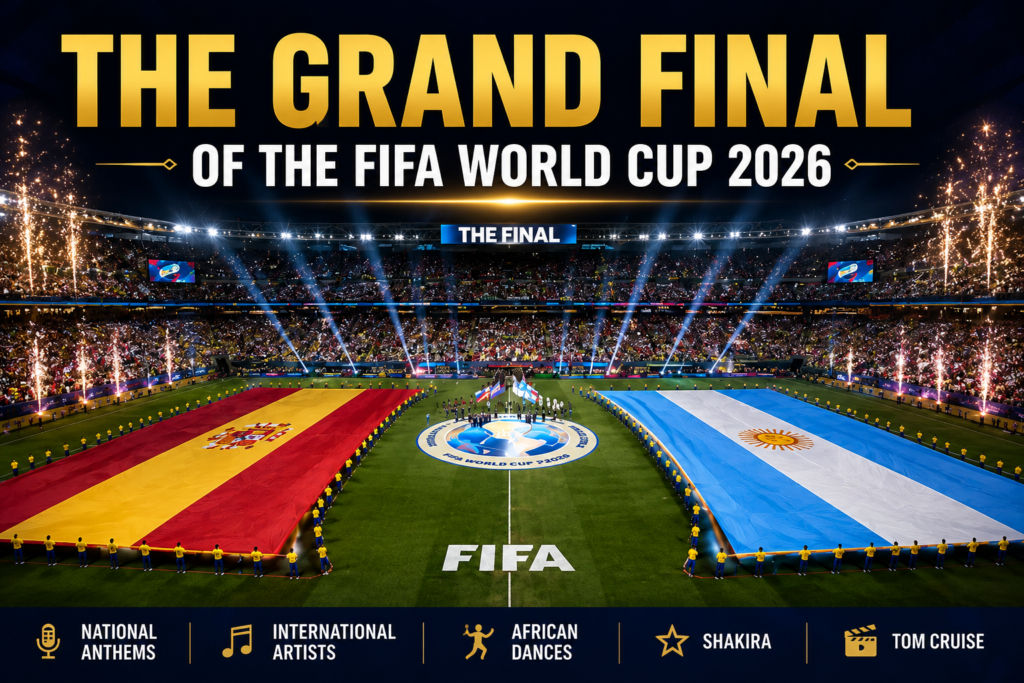
The 2026 World Cup grand final kicked off with an unforgettable spectacle, featuring the performance of national anthems and appearances by international artists such as Shakira alongside the Ghetto Kids, young dancers renowned for their spectacular African choreography.
The presence of actor Tom Cruise added even more excitement and glamour to a ceremony watched by millions of people around the globe.
Spain and Argentina face off in the grand final.
The final on July 19, 2026, pitted Spain against Argentina at New York New Jersey Stadium, commonly known as MetLife Stadium. The match kicked off at 9:00 PM (Spanish time) and marked the 104th game of the tournament.
Spain was seeking its second World Cup title, following the one won in South Africa in 2010. Argentina champions in 1978, 1986, and 2022 aimed to secure a fourth title and become the first team to successfully defend the championship since Brazil in 1962.
It was also a clash of generations and playing styles: Argentine experience versus a young, technical, and organized Spanish squad.
FINAL RESULT
Spain 1 – 0 Argentina
2026 WORLD CHAMPION
Spain's path to the final
Spain delivered an outstanding performance throughout the knockout stage. In the Round of 32, they defeated Austria 3–0. They beat Portugal 1–0 in the Round of 16, overcame Belgium 2–1 in the quarter-finals, and eliminated France 2–0 in the semi-finals.
The Spanish team stood out for its collective pressing, rapid ball circulation, defensive solidity, and ability to control the various phases of the matches.
Spain’s Path
Round of 32: Spain 3–0 Austria.
Round of 16: Portugal 0–1 Spain.
Quarter-finals: Spain 2–1 Belgium.
Semi-final: France 0–2 Spain.
Final: Spain 1–0 Argentina.
Spain was one of the most consistent teams in the tournament.
Its defense showed great solidity, the midfield dominated numerous matches, and the attack was especially effective throughout the competition.
Argentina returned to competing at the highest level.
Argentina arrived at the final match defending the title won in Qatar 2022. In the Round of 32, they beat Cape Verde 3–2; in the Round of 16, they defeated Egypt 3–2; in the quarter-finals, they beat Switzerland 3–1; and in the semi-finals, they defeated England 2–1.
The Argentine team demonstrated experience, emotional resilience, and a great ability to step up in decisive moments.
Argentina’s journey
Round of 32: Argentina 3–2 Cape Verde.
Round of 16: Argentina 3–2 Egypt.
Quarter-finals: Argentina 3–1 Switzerland.
Semi-final: England 1–2 Argentina.
Final: Spain 1–0 Argentina.
Major World Cup Controversies
The Somali referee who could not participate
One of the most talked-about incidents occurred before the tournament began. Somali international referee Omar Abdulkadir Artan was set to become the first official from Somalia to participate in a men’s World Cup.
Artan arrived at Miami International Airport from Istanbul, but U.S. border authorities denied him entry, citing issues related to the verification process.
The referee was forced to return home and was unable to complete his preparations or officiate matches during the championship.
FIFA confirmed his absence, while the decision sparked criticism and debate regarding immigration policies applied to accredited participants in international competitions.
It is important to clarify that Artan was neither sanctioned nor expelled by FIFA; his return was due to his failure to obtain authorization to enter the United States.
The controversy surrounding Folarin Balogun's red card
Another controversy arose following the sending-off of American forward Folarin Balogun during the Round of 32 match against Bosnia and Herzegovina.
Initially, the FIFA Disciplinary Committee provisionally suspended the effects of the red card, allowing the player to remain available while the case was under review.
Subsequently, the disciplinary body decided to uphold a one-match ban. This sequence of decisions sparked confusion and criticism among fans and the media, particularly due to the perception that the provisional measure might favor one of the host nations.
The incident once again highlighted the need for disciplinary decisions to be swift, understandable, and transparent for all national teams.
VAR and razor-thin decisions
Refereeing technology once again played a decisive role. Semi-automated offside technology, reviews of potential penalties, sendings-off, and goal checks helped rectify errors but also led to interruptions and debate.
Some decisions hinged on a matter of centimeters. This reignited the debate over whether technological precision always aligns with the traditional concept of gaining a clear advantage.
VAR confirmed that it can improve officiating accuracy, but also that it needs to be used with simpler, faster explanations for spectators present at the…
A World Cup followed by billions of people
The 2026 World Cup once again demonstrated that soccer remains the most popular sport on the planet.
Stadiums saw record-breaking crowds, and millions of viewers followed the action each day via television, digital platforms, and social media.
Stadiums, weather, and travel
Hosting the tournament across three countries and cities separated by vast distances posed a major challenge. Teams and fans alike had to travel thousands of kilometers and adapt to varying temperatures, time zones, and weather conditions.
Heat and storms necessitated extra precautions. There was also debate regarding the temporary turf installed in stadiums that normally use artificial surfaces.
Despite these challenges, the host cities welcomed millions of visitors and offered a multicultural celebration centered on soccer.
The tournament's standout players
Among the players who shone the brightest were promising young talents who confirmed their immense ability, alongside established stars who led their national teams throughout the championship.
The tournament also featured memorable performances from various goalkeepers, defenders, and midfielders who played a pivotal role in their teams’ success.
Major surprises of the tournament
The World Cup once again demonstrated that success is not guaranteed for any favorite. Brazil was eliminated by Norway, while Morocco delivered another standout performance and reached the quarterfinals.
Paraguay and Morocco advanced after winning penalty shootouts, and several debutant teams played competitive matches against sides with greater footballing pedigree.
England secured third place, defeating France in a high-scoring match.
A legacy for the future
The 2026 edition marked a turning point in the history of the World Cup.
The new format, the participation of 48 national teams, the growth of football in new markets, and the use of increasingly advanced technologies will make this championship a benchmark for future generations.