
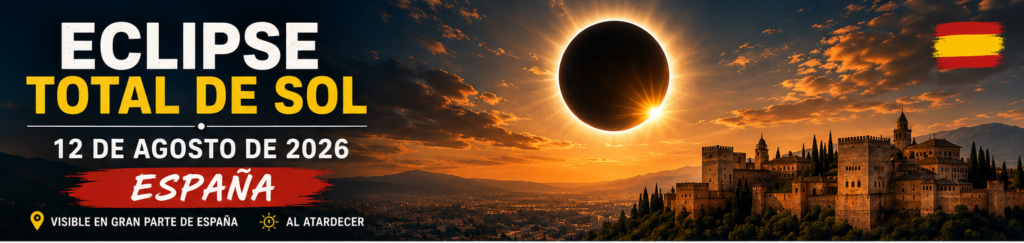
On Wednesday, August 12, 2026, Spain will become one of the world’s privileged locations for witnessing one of nature’s most spectacular astronomical events: a total solar eclipse.
For a brief period, the Moon will move directly between Earth and the Sun, completely covering the solar disk for observers located within the path of totality.
The event will be particularly historic for Spain, where more than a century has passed since a total solar eclipse was visible from the Iberian Peninsula.
🌑What is a total solar eclipse?
A solar eclipse occurs when the Moon passes between the Sun and Earth, casting its shadow onto our planet.
When the alignment is precise, the Moon completely covers the Sun for observers within a narrow region known as the path of totality.
During totality, daylight suddenly fades and the Sun’s spectacular outer atmosphere, known as the solar corona, may become visible around the dark silhouette of the Moon.
Outside the path of totality, observers will experience a partial solar eclipse.
🇪🇸 Where will it be visible in Spain?
Spain will be one of the best countries in the world from which to observe the eclipse.
The path of totality will enter the Iberian Peninsula from the northwest before moving eastward and eventually reaching the Balearic Islands.
A large part of northern Spain and the Balearic Islands will experience totality.
The path will cross areas including A Coruña, Oviedo, León, Valladolid, Burgos, Bilbao, Zaragoza, Tarragona, Valencia, Castellón de la Plana and Palma, among many others.
Farther south, the eclipse will generally be visible as a partial eclipse.
The experience will therefore vary considerably depending on the observer’s location.
🕗 A sunset eclipse
One of the most distinctive features of the 2026 eclipse in Spain is its timing.
The event will take place late in the afternoon, close to sunset.
In A Coruña, for example, the eclipse will begin at approximately 7:31 p.m., reach its maximum around 8:28 p.m., and totality will last approximately 76 seconds.
In Burgos, maximum eclipse will occur at around 8:29 p.m., with totality lasting approximately 104 seconds.
Exact times vary according to location.
Because the Sun will be relatively low in the sky, observers should find a location with a clear western horizon, free from buildings, trees or mountains.
🌘What will we see?
At first, it will appear as though a small piece has been removed from the Sun.
As the Moon continues along its orbit, more and more of the solar disk will disappear.
Daylight will gradually begin to change.
Then, for observers inside the path of totality, the extraordinary moment will arrive.
The Moon will completely cover the Sun.
The surrounding landscape will rapidly darken and the beautiful solar corona may become visible around the black disk of the Moon.
After totality, sunlight will begin to return and the eclipse will continue through its partial phases.
🌍A journey covering thousands of kilometres
Spain represents only one section of the eclipse’s enormous global path.
The path of totality will cross Arctic regions, northeastern Greenland and western Iceland before travelling across the Atlantic Ocean and entering the Iberian Peninsula.
The global maximum will occur near Iceland, where totality may last approximately 2 minutes and 18 seconds.
🌠The eclipse and the Perseids
The date offers another astronomical attraction.
The eclipse occurs around the annual peak of the Perseid meteor shower, one of the best-known meteor showers of the year.
Solar eclipses necessarily occur during a new Moon. The absence of bright moonlight will therefore provide favourable conditions for observing the night sky afterwards.
People who choose a suitable observation location could watch the eclipse at sunset and, several hours later, look toward the night sky for Perseid meteors.
☀️ IMPORTANT: Never look directly at the Sun

Solar eclipses must be observed safely.
Never look directly at the Sun during the partial phases of the eclipse.
Ordinary sunglasses do not provide sufficient protection.
Direct solar viewing requires proper eclipse glasses compliant with the ISO 12312-2 international safety standard, and the glasses must be in good condition.
Never look at the Sun through cameras, binoculars or telescopes unless they have correctly installed solar filters designed specifically for that purpose.
Concentrated sunlight can cause serious and permanent eye injuries.

📍Prepare in advance
Anyone planning to travel to observe the eclipse should prepare before August 12.
Check the exact times for your municipality, find a safe viewing location with an unobstructed western horizon and follow the latest weather forecasts.
Large numbers of astronomy enthusiasts and visitors may also travel toward the path of totality.
🌑 A historic date with the sky
More than a century has passed since the Iberian Peninsula last experienced a total solar eclipse.
On August 12, 2026, that long wait will come to an end.
For a few extraordinary moments, the Moon will completely hide the Sun over a large part of Spain.
It will be a remarkable natural and scientific event that thousands of people may remember for the rest of their lives.