
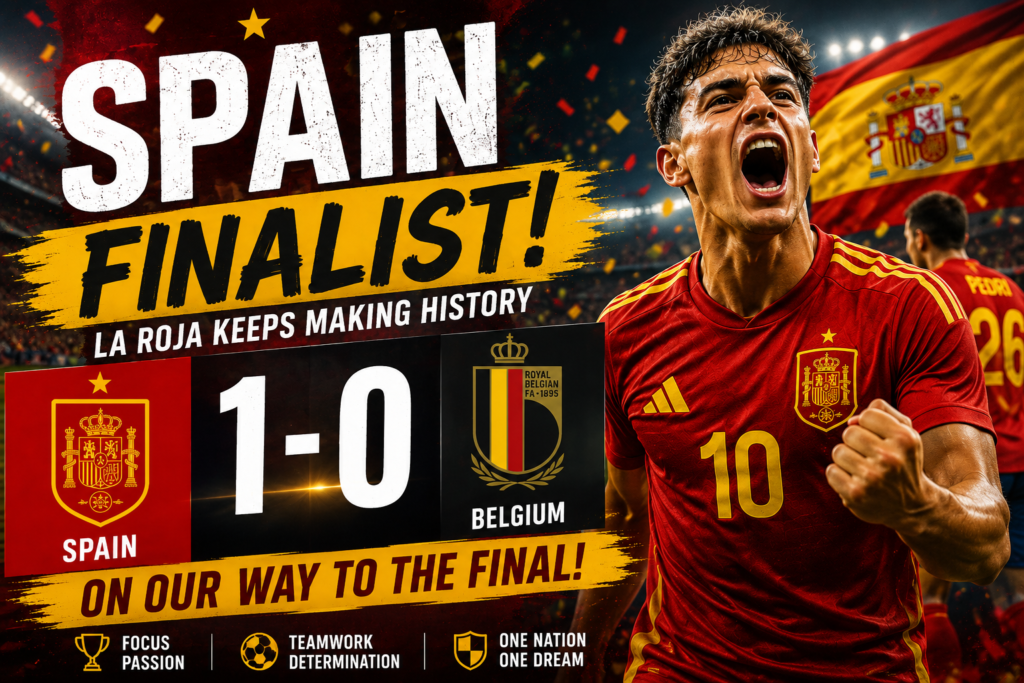
SPAIN FINALISTA
Spain has once again secured its place among the world’s best national teams by reaching another major international final.
Under the leadership of coach Luis de la Fuente, the Spanish squad has combined the energy of young stars with the experience of veteran players to overcome tough opponents throughout the tournament. Their attractive style of football, based on ball possession, teamwork, and tactical discipline, has once again captured the attention of football fans around the world.
Reaching this final confirms that Spain remains one of the strongest football nations and a serious contender for every major international title.
Spain’s success in international football has been built over many decades. The country’s first major triumph came with the UEFA European Championship in 1964.
The greatest era in Spanish football followed between 2008 and 2012, when Spain won UEFA Euro 2008, the 2010 FIFA World Cup in South Africa, and UEFA Euro 2012.
This remarkable achievement made Spain the first national team in history to win two consecutive European Championships with a FIFA World Cup in between. After a period of rebuilding, a new generation of talented players has brought Spain back to the top level of international football.
Timeline of Spain's Major International Finals
1964 – UEFA European Champions after defeating the Soviet Union (2–1).
1984 – UEFA European Championship runners-up after losing to France (2–0).
2008 – UEFA European Champions after defeating Germany (1–0).
2010 – FIFA World Cup Champions after defeating the Netherlands (1–0).
2012 – UEFA European Champions after defeating Italy (4–0).
2021 – UEFA Nations League runners-up.2023 – UEFA Nations League Champions.
2024 – UEFA European Champions after defeating England (2–1).
2026 – Spain reaches another major international final, confirming the country’s return to the top of world football and reinforcing its reputation as one of the sport’s greatest national teams.
FIFA's 2026 Financial Investment A Record Budget for Global Football Development al
The year 2026 marks one of the most significant financial periods in FIFA’s history. The 2026 FIFA World Cup, hosted by the United States, Canada, and Mexico, will feature 48 national teams for the first time, generating record revenues and enabling unprecedented investment in football development worldwide.
Record Revenue Budget
FIFA has approved a 2026 revenue budget of approximately USD 8.911 billion.
Main revenue sources include:
- Television broadcasting rights: USD 3.925 billion
- Hospitality and ticket sales
- Marketing and sponsorship rights: USD 1.786 billion
- Licensing and other commercial revenues.
.
Investment in Football Development
Through the FIFA Forward 3.0 Programme, FIFA has allocated:
- USD 2.25 billion for the 2023–2026 cycle.
- Around USD 792 million is planned for development activities in 2026.
These investments support:
- Football stadiums
- Training centres
- Coach education
- Women’s football
- Youth development
- Referee education
- Sports equipment
- National football associations
Financial Support for Member Associations
Each of FIFA’s 211 Member Associations is eligible to receive:
- Up to USD 1.25 million for operational costs.
- Up to USD 3 million for development projects.
Each continental confederation can receive USD 15 million to promote football within its region.
FIFA World Cup 2026 Prize Money
FIFA has approved a record financial distribution totaling USD 727 million.
This includes:
- USD 655 million in prize money.
- USD 1.5 million for each qualified national team to cover preparation expenses.
Top awards include:
- Champion: USD 50 million
- Runner-up: USD 33 million
- Third place: USD 29 million
- Fourth place: USD 27 million
Investment objective
FIFA’s 2026 budget represents the largest financial commitment in the organization’s history. Beyond organizing the biggest FIFA World Cup ever, the governing body plans to reinvest billions of dollars into football infrastructure, education, youth programmes, women’s football, refereeing, and long-term global development, ensuring that football continues to grow across all continents.